Home › Commercial Retaining Walls
We construct commercial masonry retaining walls in Kansas City, MO that stabilize sites and shape parking areas, walks, and landscapes. Our team works from engineered plans, installing CMU and masonry walls with proper drainage and reinforcement. Use us for property line walls, terraced slopes, and grade changes around buildings.
Superior Masonry Kansas City provides professional commercial masonry retaining walls throughout Kansas City, MO, Missouri and the surrounding area. Our licensed, insured crew delivers safe, clean, on-time work with a free estimate before anything begins. Call (414) 409-0692 or request your free quote.
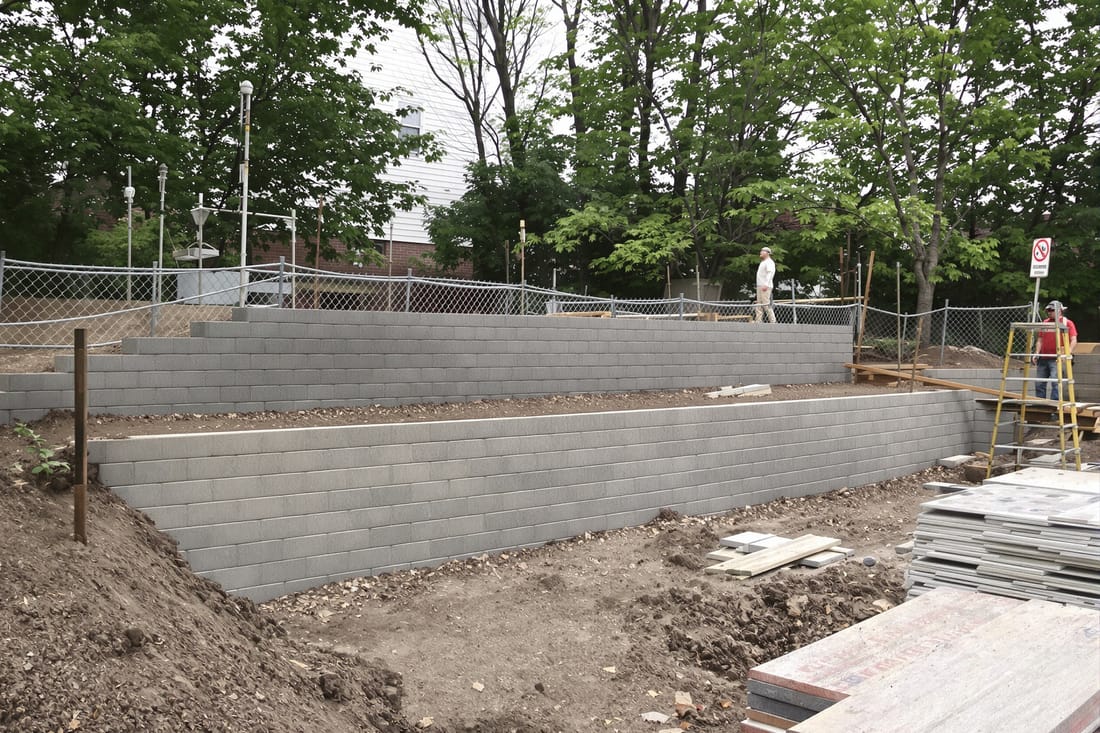
Commercial masonry retaining walls built for Kansas City properties
If your Kansas City property needs a commercial retaining wall, you are usually dealing with more than just appearance. You are controlling soil movement, protecting structures and pavement, managing drainage, and often creating usable parking or pedestrian space. At Superior Masonry Kansas City, we design and build commercial masonry retaining walls that are sized and detailed for our local clay soils, freeze and thaw cycles, and heavy rainfall events.
We work with property managers, general contractors, and owners across the Kansas City metro, from small office lots in Waldo to large industrial sites near the river. Before we ever talk about block color or facing style, we focus on what the wall has to hold back, what is above and below it, and how vehicles and people will use the space. That engineering driven approach is what keeps your new retaining wall from leaning, cracking, or flooding your parking lot during a Missouri downpour.
Whether you need a 3 foot cut slope held back at a retail entrance or a multi tier system for a warehouse expansion, we match the wall type and construction method to your site, budget, and long term maintenance expectations.
How we design commercial retaining walls that stay straight and dry
A stable commercial retaining wall starts with a site assessment. Our team walks the property, checks grade changes, notes nearby structures, utilities, and drainage paths, and looks for signs of existing soil movement. In Kansas City, we pay close attention to the expansive clay soils that swell when wet and shrink during hot, dry spells, because that expansion and contraction is a common cause of wall failure if it is not accounted for.
Next, we gather load information. For a commercial wall this usually means determining how close parking stalls, drive aisles, dumpsters, fire lanes, or building foundations will be to the top of the wall. Live loads from vehicles, especially delivery trucks and fire apparatus, significantly change the design. For walls above certain heights or carrying substantial loads, we work with local structural or geotechnical engineers to finalize calculations.
With that information, we select a wall system. Options include gravity block walls using large concrete units for rapid installation and high load capacity, segmental retaining walls (SRWs) with geogrid reinforcement extending back into the soil, and cast in place concrete walls with masonry veneers when a particular architectural appearance is required. On tight urban sites in Kansas City where there is little room behind the wall for geogrid, a poured concrete or mechanically stabilized system may make more sense.
Drainage design is just as critical as structural design. We incorporate perforated drain pipes at the base of the wall, washed rock backfill, filter fabric to prevent soil from clogging the drainage, and carefully graded outlets to move water out to safe discharge points. In our climate, where heavy thunderstorms can drop inches of rain in a short period, undersized or missing drainage is one of the fastest ways to destroy a retaining wall.
Step by step: our commercial masonry retaining wall installation process
Once design is set, Superior Masonry Kansas City coordinates layout and staging so your operations are disrupted as little as possible. We call in utility locates, verify property lines, and set wall alignment using stakes and string lines or digital layout tools. On active sites like shopping centers or medical offices, we schedule noisy or high traffic work hours around your peak times.
Excavation comes next. We dig to the required depth for the wall footing or base, which often surprises owners because it extends well below finished grade. For segmental walls, we over excavate to provide a thick layer of compacted base rock. For cast in place walls, we excavate for forms and any key or thickened sections specified by the engineer. Spoils are either reused as engineered backfill where suitable or hauled off site.
The base is then installed and compacted in lifts using plate compactors or rollers, verified with density testing for larger projects. A level, properly compacted base is what keeps the first course of block straight, which in turn keeps the entire wall true. We set the first course of blocks or forms with a builder’s level or laser, checking every piece rather than relying on eyeballing.
As we build up the wall, we add drainage stone and pipe, place and compact backfill in layers, and, when required, install geogrid at specified elevations and lengths. Each geogrid layer is tensioned back into the soil and sandwiched between block courses. On cast in place walls, we set rebar cages, install formwork, and pour concrete in a single or staged pour depending on wall height. Vibrators are used to consolidate concrete and reduce voids, which is critical in our freeze and thaw climate to limit future cracking.
After structural work is complete, we focus on finishes and site restoration. This can include masonry veneers, caps, railings or guard systems at the top of taller walls, and final grading and seeding or hardscape installation around the wall. Throughout, we coordinate inspections required by Kansas City and surrounding municipalities so your project stays on schedule.
Material choices, cost drivers, and what affects your budget
Commercial masonry retaining walls are not one price fits all. Several key factors drive cost, and understanding them helps you budget realistically and evaluate bids fairly.
Height and length of the wall are the most obvious drivers. As a wall gets taller, the need for thicker base, more substantial block or concrete, geogrid reinforcement, or larger footing sections increases quickly. A 3 foot decorative wall at a restaurant patio and a 10 foot wall holding back a truck drive may look similar in photos, but the engineering and material costs are very different.
Access and staging space on your Kansas City site also matter. If we can bring in full size excavators and material deliveries right to the wall line, production is efficient and costs are lower. In tight downtown alleys, on steep slopes, or behind existing buildings, we may need smaller equipment, hand work, and coordinated deliveries, which adds labor time.
Soil conditions are another major cost factor. Native clay that meets compaction requirements and is not overly saturated can often be reused as structural backfill, which saves trucking and material costs. If we encounter highly expansive clays, organic material, undocumented fill, or groundwater, we may need to over excavate and import engineered fill or add drainage features. That extra work is an investment in stability since poor soils are a leading cause of commercial retaining wall failures around Kansas City.
Material selection affects both initial cost and long term performance. Large precast blocks are often cost effective for tall, unseen walls along property lines. Segmental masonry units come in a range of face textures and colors suited to retail and office properties where appearance matters. Cast in place concrete with a brick or stone veneer is usually the most expensive upfront, but it may be required when you want the wall to match existing building architecture or support heavy structural loads. We walk you through these options with actual installed examples from around the metro so you are not choosing from a catalog alone.
Why Kansas City businesses hire Superior Masonry Kansas City
Commercial retaining walls are long term infrastructure, not just landscape features. When these walls fail, the damage can include collapsed parking areas, undermined sidewalks, exposed utilities, and serious liability issues. That is why Kansas City property owners and contractors look for more than the lowest bid.
Superior Masonry Kansas City focuses specifically on masonry and structural site elements, which means our crews are familiar with the details that matter: correct block batter, proper geogrid overlap, drainage outlet placement that will not freeze solid in January, and joint detailing that prevents water from getting where it should not. We have rebuilt plenty of walls that were only a few years old because these basics were missed the first time.
We also understand local code and permitting. Many municipalities around Kansas City require engineered drawings and inspections for commercial masonry retaining walls above certain heights or near public right of way. We coordinate with your engineer or provide referrals, help assemble submittal packages, and schedule required inspections so your project passes review without last minute surprises.
If you are planning a new development, expanding a parking lot, or dealing with an old wall that is bulging or cracking, we can provide a field evaluation, photo documentation, and a practical plan that fits your budget and phasing needs. Our goal is to build a retaining wall system that you do not have to think about again for decades, even through Kansas City’s freeze and thaw cycles, spring storms, and hot, dry summers.